Life can get difficult at times when you try not to fit the box, and I’ve learned many things navigating the Kinsey scale.
 Continue reading
Life can get difficult at times when you try not to fit the box, and I’ve learned many things navigating the Kinsey scale.
Continue reading
As a French national, my favorite US landmark has always been the Statue of Liberty. Its beacon is now waning.
I always thought these words would reverberate forever in the Husdon bay :Give me your tired, your poor,
Your huddled masses yearning to breathe free,
The wretched refuse of your teeming shore.
Send these, the homeless, tempest-tossed, to me:
I lift my lamp beside the golden door.
But it seems someone in his golden tower got bored and decided otherwise.

small fingers but giant mushroom clouds
Living in the Bay Area has a lots of perks, notably the climate and the people who live here– some are driven, and some maybe too much.
The Silicon Valley became fertile and successful when entrepreneurs started bringing hardcore scientific advances to the masses, with companies such as Fairchild Semiconductors, or innovative technologies, with companies such as Xerox and its Palo Alto Research Center.Nowadays, the silicon in the valley is mostly gone (I often joke that among my friends living in the Silicon Valley, I am the only one actually working on silicon… yet I don’t live in the valley:), and tech companies that have nothing to do with actual τέχνη. Yet the dreams of technology to save us all are still pretty alive. But it seems that it all has to do with hubris, or PR at best, and it is hurting actual science and those who make it. Continue readingMaybe the info was lost on all the news that trump the attention, but China has been involved with serious business in science recently. From a stage where the industry would produce with high-efficiency but with minor innovation. The country are now paving the way forward.
A few recent examples this year are pretty telling. The first one would be the launch of a set of satellites designed to study quantum encryption over long distances. Apparently, this project was proposed by leading German scientist Anton Zeilinger to the European Union, but never got through (update Oct 28th, 2016 : Now there’s a event a 2000km quantum link project underway in China. Wow!) Continue readingDear reader,
I haven’t been very communicative lately, for I was kept busy by a very cool new venture : the birth of the Berkeley Lab Postdoc Association. The new association is meant to bring together over a thousand postdocs at Berkeley Lab, and provide them with support, career advice and bring feedback to the lab management about issues encountered by postdocs. Now that the association is alive and well (see the blog), I can tell a little about its story. Continue reading
The internet may still be less than 10,000-days old, it still fails to deliver for scientists.
By empowering institutions to efficiently track down the number of publications, pushing even further the drive to publish many half-baked ideas and follow the hype instead of long-term research. It is true that it had never been as simple to get access to a paper and makes life easier on many aspects– collaboration often just requires sending an email, but new hurdles have appeared, and these should be removed.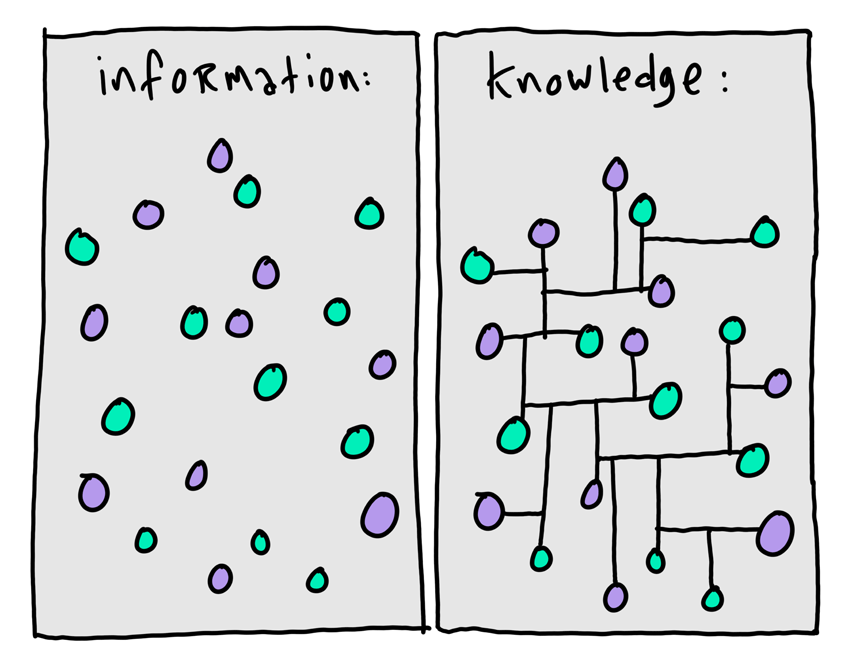 Here is a bunch of ideas on how to use the new digital tools we have at hand to make research easier and thus more efficient, and a limited overview of what we have now. Continue reading
Happy New year !
The notion of free will is a very interesting one, and as we are living in a time where people are talking of robot intelligence and where people are still adamant about religion and what they call or perceive as “freedom”, I think it’s only fair to remind this brilliant excerpt from “Religion and Science” by the late Bertrand Russell, that among all the great things he wrote struck me with its clarity and depth.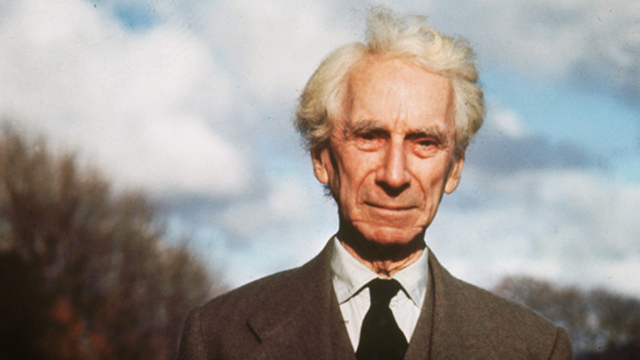 (yeah, I’m bootstrapping on Maria Popova’s Brainpickings !)
Psychology and physiology, in so far as they bear upon the question of free will, tend to make it improbable. Work on internal secretions, increased knowledge of function of different part of the brain, Pavlov’s investigations of conditioned reflexes, and the psycho-analytic study of the effects of repressed memories and desires, have all contributed to the discovery of causal laws governing mental phenomena. None of them, of course, have disproved the possibility of free will, but the have made it highly probable that, if uncaused volitions do ever occur, they are very rare.
Here’s a bunch of resource where you can find cool seminars by some hardcore scientists (I mean not the kind of pseudo-scientific, inspirational talks that you’ll find over the web).
yup, that’s me
Feynman’s talk are an endless source of excitment. Project Tuva are a must-see, but many other videos are available on Youtube (Fun to Imagine, the pleasure of finding things out)
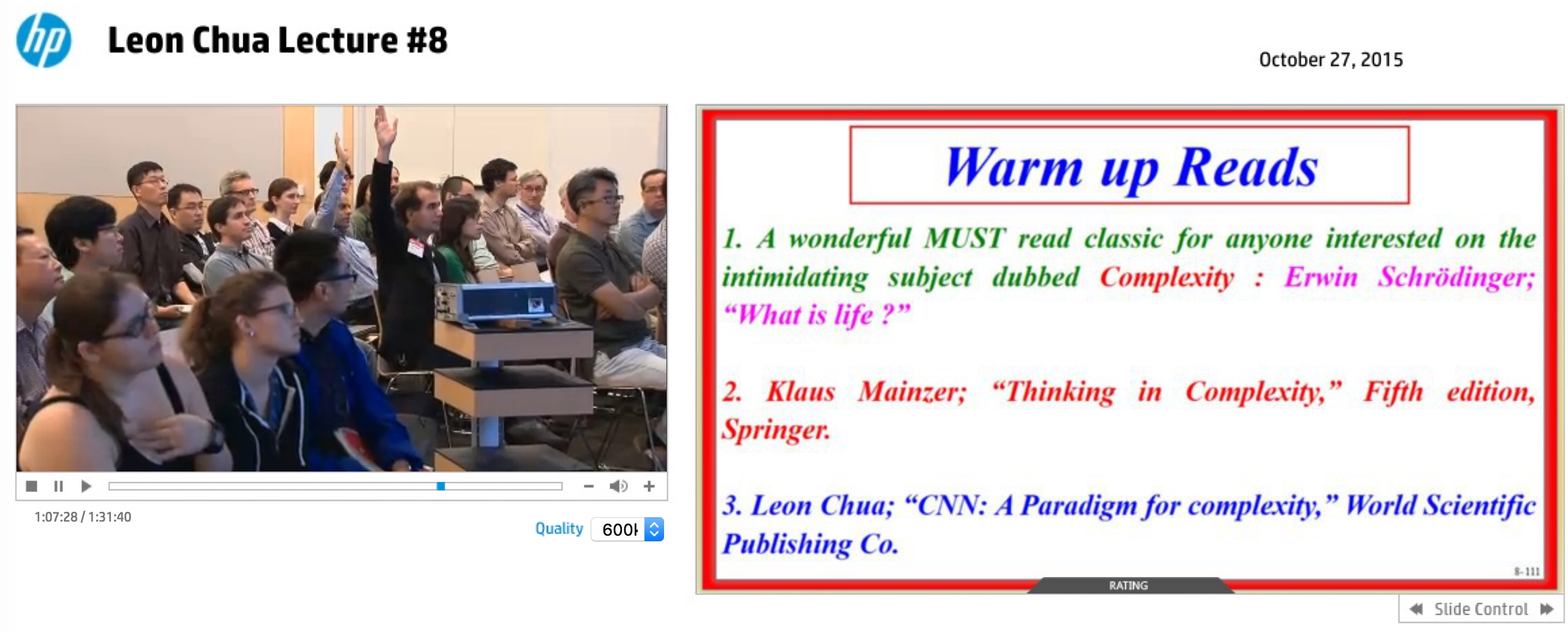
The Chua’s Lecture – Very recent lectures on memristors and chaos– fascinating !The Royal Institution – very cool videos about scienceEdge – There’s a lot of cool videos on a wide variety of subjectsLes Ernest – L’ENS offre un grand nombre video (15 min) sur toute sorte de sujets, par les plus grands experts du domaine.
Seminaire General du departement de Physique de l’Ecole Polytechnique – traitement nettement plus poussé (1h) sur un sujet particulier de la physique.Enjoy !I wrote a feature article for the Fall issue of the Berkeley Science Review (BSR) about the resources available for PhDs when they want to turn their research into companies.
Here it is : Cyclotron Valley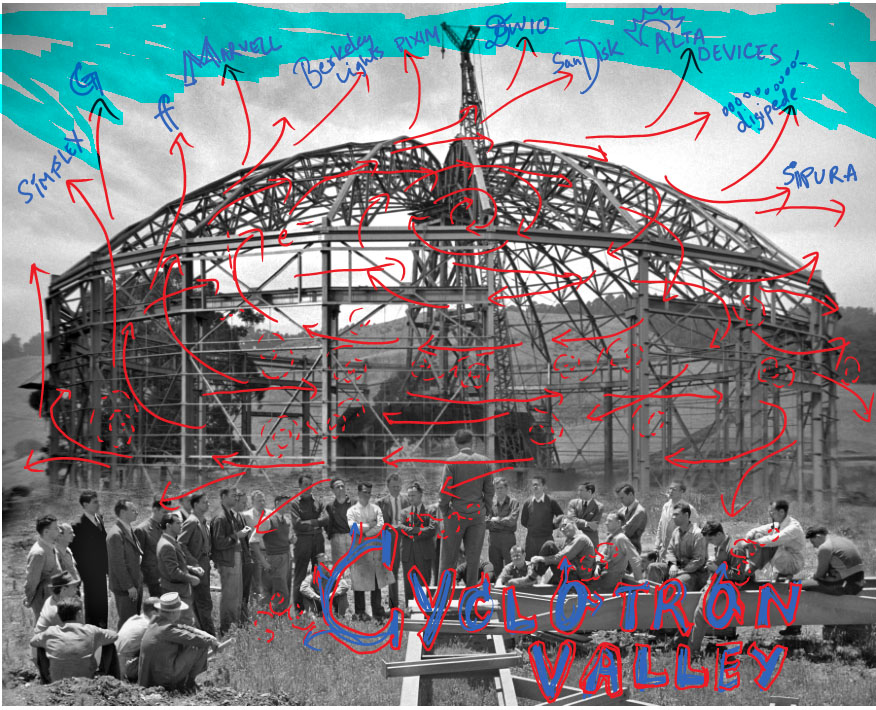
One of the proposed cover designed (credit: Indrasen Bhattacharya)
Both research and entrepreneurship also require another crucial skill—flexibility. The academic must choose from many potential research paths and be prepared to alter his or her plans when experiments predictably don’t work. In the parlance of Silicon Valley, this is known as the pivot—an attempt to assess the validity of your current direction and then use that knowledge to devise another idea that works better.
This is part of my involvement with the Berkeley Postdoc Entrepreneurial Program (BPEP), the first association promoting entrepreneurship among skilled researchers, run by volunteers.
edit 12/20/15 : I’ve just read The Entrepreneurial State by Mariana Mazzucato. Quite interesting discussion on the (true) origin of innovation. Here’s a video that roughly summarizes the book.Back in november, I met Art McDonald, who had bee recently awarded the Nobel Prize in Physics (together with Takaaki Kajita), for its research in determining whether neutrinos have a mass or not– now we know they do, but we don’t know how much !
His big tool, the Sudbury Neutrino Observatory (SNO) has a cool name, and I asked him to draw a snowflake. He wasn’t very sure how to do it, but he had a pin’s to help him :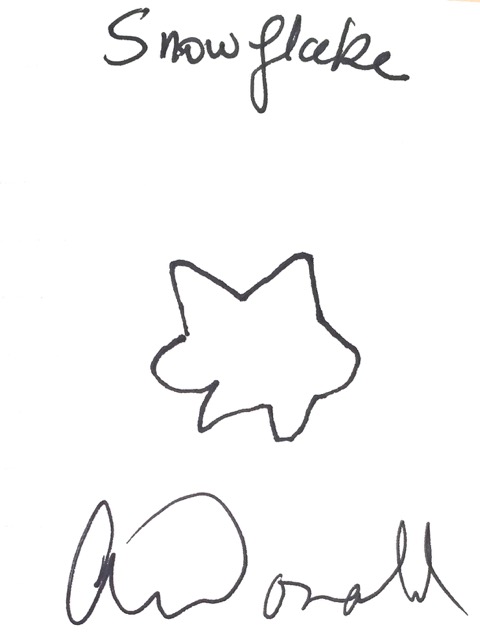
Art MacDonald’s drawing
That’s a great addition to my collection ! I thought Jennifer Doudna would be promoted to the list too, but… not yet!